Private Chat Apps: How Digital Communication Platforms Handle Privacy Differently
Private chat apps are not just chat screens on your phone. An entire digital communication system runs in the background. Servers, infrastructure, software layers, and data pipelines all work together to move every message. What you see is simple, but what carries it is a complex system.
And of course, there is a whole architecture behind it. You can even call it an entire system working like an unseen framework around every message. So the point here is: when much is going on behind the scenes of an app, why do we just accept one part of the system and trust the platform for privacy and security?
Privacy must be at the whole architectural level.
Therefore, this concept means that digital communication platforms must be designed so that it becomes very hard to connect conversations back to a real person, i.e their identity. Most particularly, instead of relying on fixed identities like phone numbers or email addresses, it reduces or removes the information that normally links messages to users. The focus is on limiting what can be seen about who is talking, when they are talking, and how often, so that communication is not easily mapped back to an individual or their network.
Nonetheless, that does not mean these apps are doing no work at all. Most secure messengers are supposed to keep your conversations private, and most of them do, sort of. They encrypt the messages themselves. But then comes the rest.
The other digital communication platforms ask for your phone number or, in some cases, other identifiers such as your email address. They know your contacts and have permission to access the devices. They track which accounts you talk to and when. The encryption is strong, but the data collection around it is stronger. The data privacy in digital communication must be about not collecting data instead of collecting it and then protecting it.
Building on this, xPal is a private chat app designed to reveal as little about you as possible because it knows nothing else. Encryption is strong, no long-term data is stored on servers, no larger integrated ecosystem, patent-approved technologies, potent privacy and security, no information exists beyond the message itself, and most importantly, xPal has nothing that reveals the true identity of users because there is no data storage model.
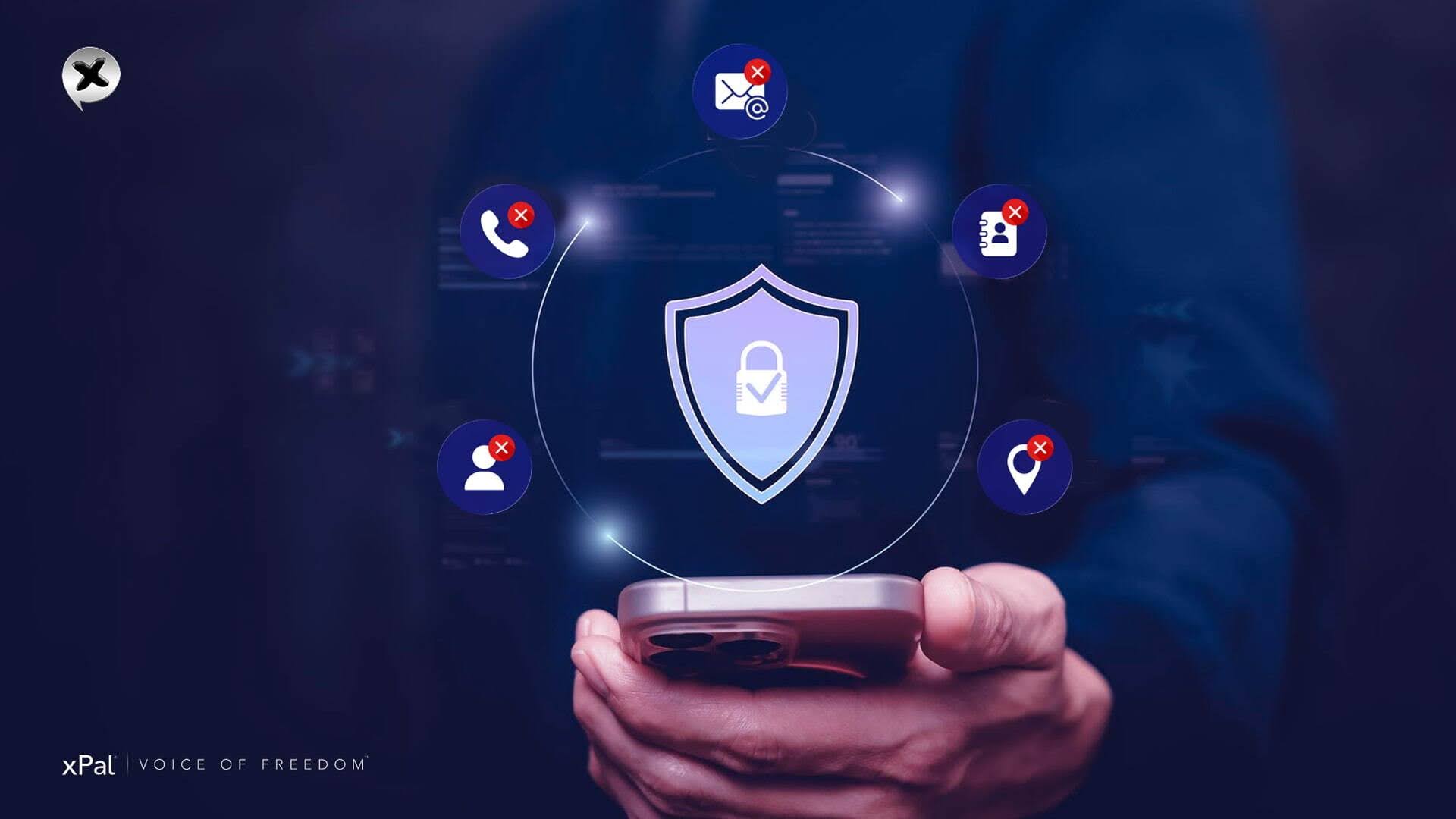
What Is the Difference Between Zero-Collection and Protect-What-You-Collect Privacy Models?
| Aspect | Zero-Collection Model | Protect-What-You-Collect Model |
|---|---|---|
| What is the main goal of the system? | The system avoids collecting user data whenever possible, prioritizing data privacy from the start. | The system collects certain data and focuses on protecting it through privacy and security controls. |
| How does the system handle identity? | Identity is minimized or separated from communication wherever possible, following a privacy-first approach. | Identity is usually part of the account structure and user experience. |
| Is personal information required to get started? | Access can often be provided with little or no personal information. | Registration commonly depends on information such as phone numbers or email addresses. |
| How is metadata handled? | The system attempts to reduce the amount of metadata that exists. | Metadata may exist in the platform. |
| How are contacts discovered? | Users typically connect through direct sharing or manual discovery methods. | Contact discovery is often built into the platform experience, like permissions or integrations. |
| What happens if platform servers are compromised? | There is no user information available because no information was collected and nothing is permanently stored. | More information may exist, although it is protected through security controls. |
| How does the platform view user relationships? | The system tries to avoid building detailed maps of user connections. | User relationships may be visible as part of the platform's working. |
| How does the platform approach privacy? | Privacy starts by limiting what information enters the system. | Privacy starts by securing information after it enters the system. |
| What does the platform need users to trust? | Users mainly trust the platform for not collecting as much data as possible. | Users trust the platform to store, manage, and protect collected data responsibly. |
| How does the model affect personalization? | Personalization is limited because little information is available. | More personalization is possible because more information exists. |
| How are legal or regulatory requests affected? | There is no information available to provide. | Information may be available depending on what is stored and retained. |
| How does the model influence feature design? | Features are often designed around privacy from the start, which is common among the most secure messengers. | Features are often designed first and then protected with privacy controls. |
| What is the long-term privacy risk? | Risk is reduced because less information exists over time, strengthening data privacy. | Risk depends on how securely collected information is stored and managed. |
| How does account recovery usually work? | Recovery options exist, but again do not depend on users' personal data, supporting a No Personal Data approach. | Recovery is often easier because account information is available. |
| What preferences does the model make? | The model generally prioritizes privacy while balancing convenience in digital communication systems. | The model generally balances convenience with privacy and security protections. |
Building on that, conceptualize most large-scale platforms, most secure messengers, apps, or sites you use or visit.
Either they require an existing account, personal identifiers like phone numbers or email, locations, and country codes, preferably. These become the foundation, and everything builds from there. Your activity carries identity, and simply the architecture says: “We will protect your message content incredibly well, but we will know everything about your identity and relationships.”
Although the encryption is competent and mathematically sound in digital communication platforms. But the architectural distinction is that the platform collects and maintains identity data from the beginning, and platforms are vocal or transparent about this.
But the central point is that we can’t really change the system once it is already built a certain way. If the design is set, we can just follow that structure, not the other way around.
This might sound acceptable to many people because what often goes unnoticed is how easily people end up surrendering control, privacy, and security without realizing it, simply by accepting how systems are already designed as “normal.”
As it turns out, not all systems are built that way. Some are structured so that user data and identity are never central to how the system works in the first place.
Does xPal collect user data or operate on a zero-collection model?
When we are all drenched in data extraction models, believing a zero-collection model like xPal is not a normal sip of coffee at first. Understandable!
So yes, xPal is a minimal-data-collection platform, and greatly convenient and developed, user-friendly, but clearly not that toxic communication platform that wants to know all about you unnecessarily. For the xPal secure digital communication platform, privacy and security, as always, are the greatest priority, and it doesn't collect the data in the first place, honoring data privacy.
Users don't sign up with a phone number, don't provide an email address, and don't upload the contacts. You get a random 9-digit number, an xID, that is attached to no identity or profile.
xPal does not store data on its servers, has end-to-end encryption with patent privacy features, third-party independent audit (DEKRA, NIST, OWASP, and MASA), and gives users greater control over their data.
Extending this, in xPal there is far less to protect and far less to leak, nothing to be subpoenaed for because no user data exists, and nothing to protect because nothing was collected.
The simple point is, xPal does not take the diamond and then build a castle around it to protect it. It simply never collects the diamond in the first place, so there is nothing stored, tracked, or exposed later on.
Why is validation meaningful in Privacy Systems, and What It Actually Proves?
Validation of a secure communication platform is crucial because how would we know what is being told is true about the privacy and security of digital communication? So, the question arises;
What is the validation approach of xPal?
xPal completed NIST CAVP validation in January 2026. NIST, the National Institute of Standards and Technology, a U.S. federal agency, ran independent laboratory testing on xPal's cryptographic implementation. The labs verified that the encryption algorithms work exactly as specified in federal standards.
This is different from auditing the whole platform. CAVP validation is specifically cryptographic verification. It is saying that the math is sound and the implementation is correct.
Then xPal underwent three consecutive years of security audits from DEKRA, one of the world's largest testing and certification organizations. It is not one audit but three: Mobile Application Security Assessment (MASA) testing in 2023, 2024, and 2025.
What does that tell you?
The credibility of a private chat app is not something proven once and carried forever. It is what remains when systems are repeatedly tested, corrected, and expected to behave the same way tomorrow as they do today. Not just perfect on launch, or in presentation, or marketing on social media, but consistent in reality with privacy and security integrated like DNA.
FAQs
1. If an app encrypts messages, why does metadata matter so much?
Metadata answers: who you talk to, when, and how often. Sophisticated analysis of metadata can reveal as much as reading actual messages. A government agency seeing you talk to certain people at certain times can reduce your area of involvement in activism without reading a single message. So most secure messengers can encrypt content but not relationships.
2. Can most secure messengers or apps be fixed? Will they eventually encrypt metadata?
Not without redesign. Encrypting metadata would require removing the tie between accounts and identity-linked social graphs. That defeats the entire value proposition of platforms built around existing networks. It is related to the whole architecture, not a bug they are fixing.
3. Is xPal's NIST CAVP validation better than other approaches?
CAVP is federal cryptographic verification (the math is sound). Independent security audits are comprehensive system reviews (the system is secure). Both matter. xPal adds continuous validation over time. Other approaches often rely on point-in-time assessments. Both approaches are valid, but they test different layers of trust.
4. Can I use xPal if nobody I know is on it?
Technically yes. Practically, only if you have specific people who will join. xPal’s value is in talking to people who choose to be on a privacy-first platform. Using it alone is like having a vault with nothing to store.
5. Does tight integration with large social ecosystems make an app less private?
Not in terms of message encryption. But it usually means your account is tied to identity systems, metadata becomes more exposed, and you inherit the network structure of that ecosystem. The encryption strength can still be strong. The architectural privacy and security surface is what changes.
6. Why don’t most apps pursue CAVP certification?
CAVP is specifically cryptographic validation, not a general security certification. Many consumer platforms don’t pursue it because it requires effort, specialization, and ongoing alignment with federal testing standards. It is uncommon in mainstream messaging products. xPal is part of a small group that does.
7. What happens if xPal shuts down?
You lose local data on your device. But there is no centralized trove of messages to leak because xPal doesn’t store them long-term; messages are encrypted and deleted shortly after delivery. The risk shifts from server exposure to local device responsibility.
8. Do I need a privacy-focused app if I have nothing to hide?
Privacy is not about hiding. It is about control over exposure. Most data exposure has nothing to do with wrongdoing.
9. Can a platform be private if it connects to a social network?
It can be secure, but not fully private in the strict sense. Connection to a social graph inherently creates traceable relationships. Privacy decreases as connectivity increases.
10. Why do most secure messengers avoid talking about metadata?
Because it is harder to simplify into marketing language. Encryption can be shown as “strong” or “military-grade.” Metadata cannot be easily framed without revealing uncomfortable realities about how systems operate.
11. Why do most users underestimate data privacy risks?
Because the effects are invisible. There is no immediate signal when data is interpreted, combined, or profiled. The impact accumulates silently over time, which makes it psychologically easy to ignore.
12. Should privacy be a default or a choice in digital communication?
Privacy and security cannot be a choice inside systems that are designed against it. Defaults always win over intention.