xPal vs XChat: What Makes an Anonymous Text Messages App Truly Private?
Building an anonymous text messages app as part of a larger platform comes with challenges that are not always obvious at first. But when a new app launches inside an ecosystem that people already know and trust, opinions tend to form before anyone looks at how it actually works. The first things people hear often shape what they believe, and the hype can make it easy to overlook the bigger picture.
The metadata-free messaging, or no Personal Data collection models, are the facts that people don't decide upon. What is comprehensively believed is what is trending! Definitely, who thinks about the whole architectural technicalities, the cons of integrated systems, beyond end-to-end encryption, audits, or validations, barely most people even know this.
But let's understand something here, even if you don't want to run through privacy policies and whitepapers.
There are two approaches to building encrypted messaging: an isolated architectural model and an ecosystem-integrated one. The isolated model is designed as a closed system: minimal external dependencies, reduced data surface, and tighter control over what the system ever needs to know. That is the approach xPal is built on.
The integrated model embeds encryption into platforms people already use. That is the direction xChat is attempting.
The difference between those two approaches is privacy. It is harder to implement when you are building a system that has to work with all the existing infrastructure, habits, and integrations people already depend on.
xChat exists as an encrypted messaging layer within X, which used to be Twitter, which is now owned by a company that was previously owned by another company, which is now partnered with AI companies in ways that are still being negotiated. That complexity is more than the confusion in this sentence, and it matters because privacy in that context can be an engineering problem with competing constraints if not addressed responsibly.
In the simplest possible words, xChat is part of a much larger ecosystem. Because of that, secure communication is only one of many things the system has to balance. The challenge is not encryption itself, but how privacy fits into a platform designed to do many different things at once.
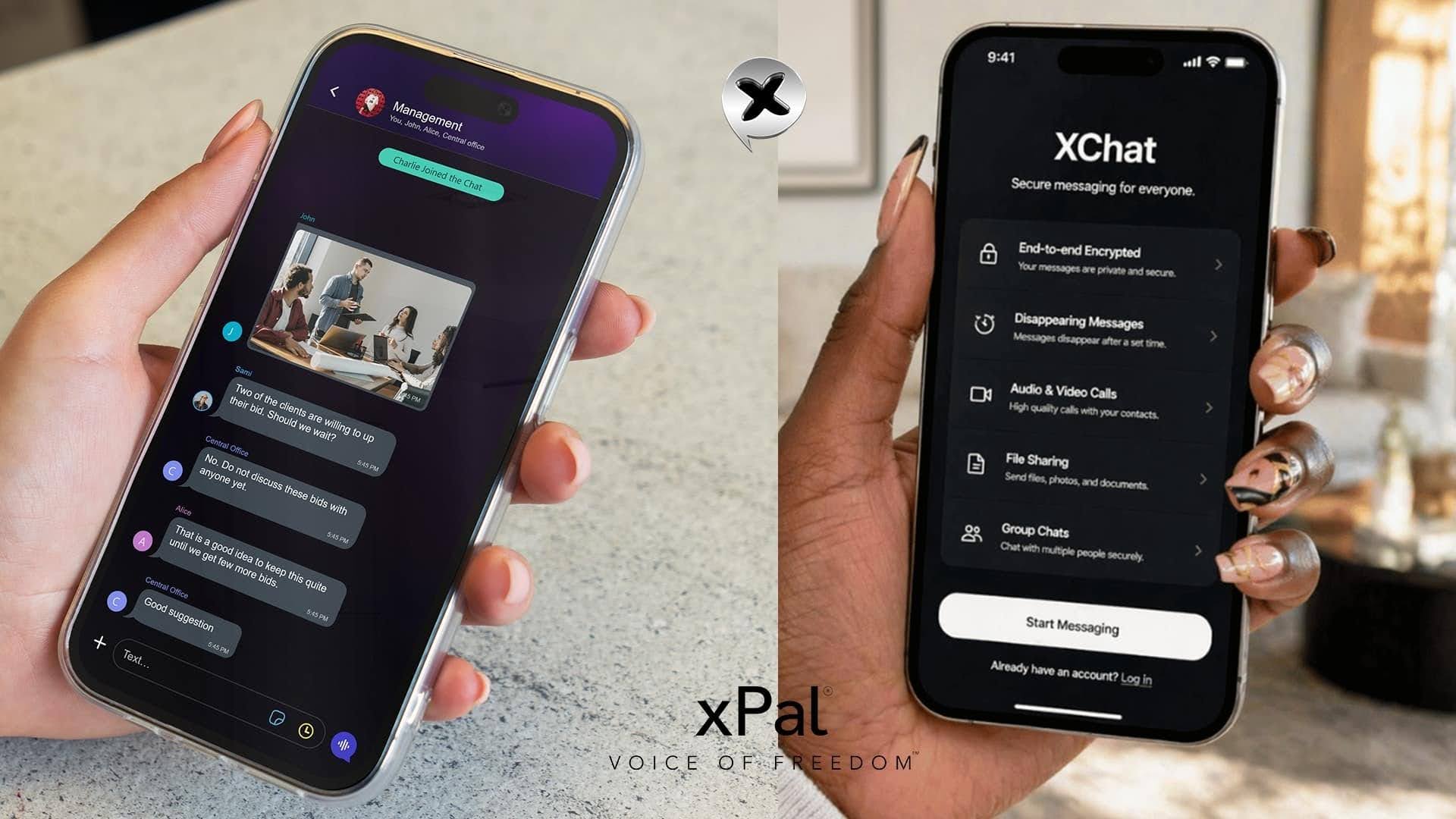
Why does integrating an anonymous text messaging app into larger platforms create a problem?
When X launched encrypted messaging, they didn't start with a blank slate. They had an existing user base that already knew each other, already had follower relationships, and already had DM histories. They couldn't ask everyone to create new accounts or learn new identities. People needed to sign in with their existing X account and immediately message the people.
This sounds like a feature advantage, preferably "everyone you know is already here." Technically, it is, and people see the convenience. But it creates a privacy question because secure communication must support metadata-free messaging and collect No Personal Data in its secure chat app.
In xChat, the encrypted conversations happen within a system that knows exactly who you are because you logged in with your X account.
Looking at it another way, the xPal private messaging app is convenient, fully developed, architecturally private, independently audited and validated, has patent-approved technologies, and has made anonymity the foundation.
xPal has an xID rather than asking for personal data for registration or sign-up. Your xID is disconnected from your identity.
xChat can encrypt your messages, which means the content is hidden from X employees. But you are still using a real account, still logged in as yourself, and still connected to a visible identity.
So while the message content is private, the system still knows who you are, who you interact with, and who follows you.
Now it is up to you to see and contemplate the difference: either you see both privacy as equally important or otherwise, because this difference changes how you understand trust in any private messaging app.
Why is metadata in integrated systems still a privacy problem even when end-to-end encryption is used?
If you use xChat to message someone, here is what X's servers know:
- Your X account identity
- The recipient's X account identity
- When the message was sent
- That you have a relationship (you can message each other)
- If you share a follow relationship or mutual DM history
Here is what X's servers can't know:
- The content of the message (it's encrypted)
- Content privacy can be very strong. Encryption can do its job well.
But metadata is a different layer entirely in secure communication. Metadata-free messaging doesn’t need to read your messages to understand what is happening.
From this, you can start to understand who is connected to whom. Whether someone is a colleague, a competitor, a journalist, or someone they should not be talking to anymore. None of this requires reading the actual messages. The timing and frequency of communication are often enough.
The story is not in the words themselves, but in the behavior around them. Even if the content is fully hidden, patterns alone can still reveal meaning; that is why metadata-free messaging is important. The message may stay private, yet the structure of secure communication can still tell its own story.
The distinction in the xPal anonymous text messages app, on the other hand, is that it does not store the amount of metadata the system naturally retains. This leaves no information available to analyze, store, or potentially misuse later.
Not only xPal private messaging app have metadata-free messaging, but it also works on a no-personal-data collection model, certifying that architecture can exist without threatening user privacy and security.
xChat works within a different framework. Because it exists within a larger platform, certain metadata has to persist for the service to function. The system needs to know where messages are going and which accounts are communicating, even if the content itself remains encrypted.
That said, for many people, encrypting message content is enough. It prevents others from reading private conversations, which is a significant layer of protection. But content is only one part of secure communication.
What happens when your AI assistant is not encrypted, and what risks does that create?
This is a problem most systems still handle poorly, and xChat is no exception.
xChat integrates Grok, X’s AI assistant, directly inside an encrypted messaging interface. On the surface, it feels seamless. You stay inside a private chat, you ask a question, and you get an instant response.
But the moment you involve Grok, the boundary changes because the text you send to the AI is no longer confined to the encrypted conversation. It has to be processed externally on Grok’s servers, outside the end-to-end encrypted layer. At that point, it is no longer protected in the same way as your message thread.
xChat is open about this, and the system clearly explains where that boundary exists in a secure chat app environment. What you are left with is not a broken system, but a split one: a private messaging app handling encrypted communication on one side, and AI-assisted processing that necessarily steps outside that boundary on the other. It aims for secure communication, but it is not designed as metadata-free messaging or a no-personal-data architecture, since some processing requires leaving the encrypted layer.
However, the xPal private messaging app avoids this and does not embed an AI layer inside the messaging system, and there is no direct bridge between private communication and model processing. The two systems remain separate.
Instead of making a data store or having paths of data points, it is far better not to collect data in the first place.
What makes the certification question complicated in privacy and secure systems?
Both xPal and xChat have been audited. xPal is certified by DEKRA and validated by NIST CAVP. XChat by Trail of Bits. So we can trust both, right?
Not the same way.
According to TechCrunch,
XChat, X’s standalone messaging app, is now available for iOS users and brings messaging, file sharing, voice and video calls, and group chats tied to X contacts. It was previously tested with a limited beta group before being expanded more widely, and it sits within X’s broader shift toward building multiple connected services such as messaging and payments rather than a single unified “everything app” vision.
What makes XChat more complex is its integration into X’s wider ecosystem. It is not a fully isolated product but part of an interconnected system where identity, contacts, and communication layers are tied back to the main platform. This creates a tightly integrated architecture where messaging, social data, and account systems overlap.
The app promotes privacy-oriented features such as end-to-end encrypted chats, PIN protection, message editing and deletion, disappearing messages, and screenshot blocking, and it claims to avoid ads and tracking, presenting itself as an anonymous text messages app designed for secure communication. However, security experts have questioned how strong its encryption implementation is compared to more established encrypted messaging systems.
At the same time, XChat is absorbing X Communities, which are being phased out due to low activity and spam issues, potentially driving early user migration into the app. Overall, it represents an early step in X’s evolving messaging strategy, with further development expected as part of a larger integrated ecosystem rather than a standalone, fully independent system.
What is forward secrecy, and why does it create feature gaps in secure messaging systems?
Forward secrecy is a security feature in a private messaging app that makes sure your old messages stay safe even if your account or encryption keys get stolen later.
Here is a simple way to understand it.
When you send messages, the secure chat app uses temporary keys to lock (encrypt) them. These keys change frequently, so even if someone manages to steal a future key or hack your account later, they still cannot go back and unlock your old conversations. Each message is protected in a way that does not depend on one long-term key. That is forward secrecy.
Now the important part: why it creates limitations in secure communication.
To make forward secrecy work, the system must constantly change and discard old keys. This limits what the private messaging app can do with old messages. For example:
- It becomes harder to sync full message history across devices in a simple way
- Some backups and cloud features become more complicated
- Searching old messages across devices can be restricted or more complex
- Multi-device access needs extra design to stay secure
You get stronger protection for old messages, but the system becomes less flexible in how it stores, syncs, or reuses message data.
That is why forward secrecy is powerful, but not “free” in secure communication.
XChat's current encryption doesn't implement forward secrecy. That means if someone steals your device's private key, they could decrypt all of your past messages. XChat acknowledges this and says they are working on it. But it is not there yet.
xPal private messaging app implements stronger key management because xPal had the freedom to make that choice without coordinating with broader platform infrastructure.
If any of you are confused and still thinking;
What does "Private" actually mean in each secure communication context?
Let's simplify!
If you ask someone, "Is XChat private?" and someone else asks, "Is xPal private?" you will get the same answer: Yes, both are encrypted. But they mean different things.
xPal is a private text messaging app in the sense that the system cannot identify you, cannot see your contacts, cannot know who you are talking to at the platform level, and cannot surveil your secure communication history because the history is not persistently stored on the platform. The message content is encrypted, but more importantly, the metadata about the message is short-lived and de-identified.
XChat is private in the sense that the message content is encrypted and cannot be read by X employees, that end-to-end encryption prevents interception, and that nobody can tamper with messages in transit. But X still knows who is talking to whom, maintains your identity, and stores metadata, but you are just encrypted.
Cutting through the noise, you can explore the features and whole setup of xPal private messaging app and start your journey toward greater privacy and control!