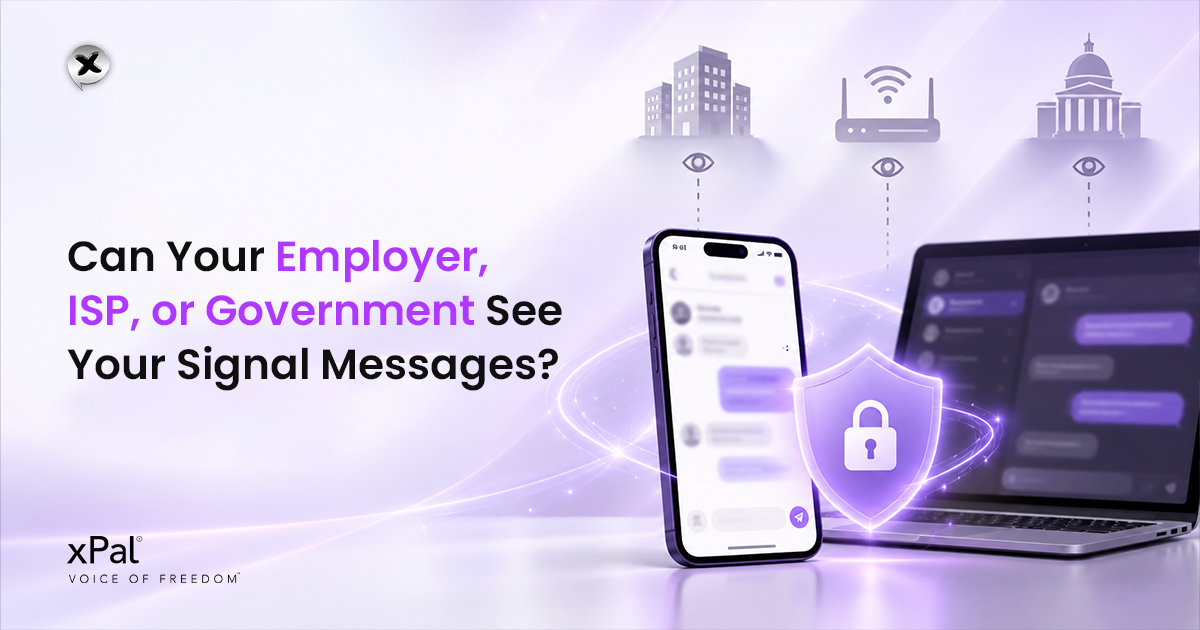
Can Your Employer, ISP, or Government See Your Signal Messages?
Signal is widely respected as one of the strongest mainstream private messaging apps. It uses end-to-end encryption for messages and calls, and Signal says it cannot access the contents of users’ messages, calls, profiles, groups, contacts, or call logs.
That is reassuring, and it matters. But the complete answer is more nuanced.
Your employer, internet service provider, or government generally cannot simply open Signal and read your encrypted message content. However, they may still learn other things depending on the device, network, workplace rules, phone ownership, account setup, legal authority, and the people involved in your conversations.
The important distinction is this:
Signal is highly effective at protecting message content, but content privacy is not the same as complete identity privacy.
This guide explains what Signal protects, what it cannot fully protect, and why people researching a private messaging app should think beyond message encryption alone.
The short answer
Signal’s end-to-end encryption is designed so that the sender and intended recipient can access message and call content. Signal states that it does not have access to messages, calls, profiles, group information, contacts, stories, call logs, and many other types of content and metadata.
However, that does not mean every party is unable to learn anything about your Signal use.
| Who might see something? | Can they read Signal message content? | What they may still learn |
|---|---|---|
| Your employer | Usually no, unless they control or access your device | That Signal is installed or used, network activity, screenshots, device records, or data from managed devices |
| Your ISP | No | That your device connected to Signal infrastructure, connection timing, data volume, and IP-related network information |
| Government or law enforcement | Not ordinarily from Signal message content | Information available from devices, network providers, other people, or valid legal requests for limited account data |
| Signal recipient | Yes, by design | Everything you send them, including content they may screenshot, copy, forward, or record |
| Someone with access to your unlocked phone | Potentially yes | Chats, attachments, notifications, and stored data visible on the device |
The details matter because privacy is not only about encryption. It also includes your device, identity, network, contacts, and personal security habits.
Can your employer see your Signal messages?
For most people, an employer cannot read the contents of Signal messages just because Signal is installed on a personal phone.
End-to-end encryption means message content is protected between you and the person you are communicating with. Signal says it cannot provide access to messages or call content because it does not have it.
However, workplace situations can be different.
Your employer may be able to see more if:
- You use a company-owned phone, tablet, or laptop.
- Your device has mobile device management software installed.
- You use a workplace Wi-Fi network.
- You connect through a company VPN.
- You store Signal attachments in a company-managed location.
- Your phone is unlocked or physically accessible.
- You display Signal notifications on a work screen.
- You send information to someone who later shares it.
A company-managed device may record installed applications, security events, device identifiers, or network activity. Encryption can protect the message content in transit, but it cannot stop device-management software from seeing that an app is installed or active.
If you are concerned about workplace monitoring, separate personal and work devices where possible. Keep your device updated, use a strong screen lock, review notification settings, and avoid sharing sensitive personal information through a device owned or managed by your employer.
A secure messenger is most effective when it is used on a device you control and protect.
Can your ISP see Signal messages?
Your internet service provider cannot normally read the actual words, photos, voice notes, or call content inside a Signal conversation.
Signal’s encryption protects that content while it moves across the internet. Your ISP sees the encrypted traffic, not the readable message itself.
Still, an ISP may be able to observe network-level information, including:
- That your device connected to Signal-related servers.
- The time you connected.
- The approximate duration of a connection.
- The volume of data sent or received.
- Your IP address.
- The general location associated with that IP address.
This information is commonly called network metadata. It does not reveal what you said, but it can reveal patterns of communication.
For example, an ISP may not know the content of a Signal call, but it may detect that your phone used encrypted traffic at a particular time and that a large amount of data was transferred. That is very different from reading the call itself.
This is why a secure messaging and calling app should be evaluated not only for its encryption but also for its approach to data minimisation, identity protection, and privacy controls.
Can the government read Signal messages?
A government agency cannot normally ask Signal for the content of messages and calls and expect to receive readable conversation transcripts.
Signal’s published government-communication page says it does not have access to messages, calls, contacts, profile information, group information, call logs, and other information that it could provide in response to a valid legal request.
In a published response to a United States grand-jury subpoena involving 37 accounts, Signal reported that seven accounts did not exist, it had no responsive information for 24 accounts, and it provided responsive information for six accounts.
This is a strong example of privacy-by-design. A service that does not retain broad quantities of user data has less data available to disclose.
However, encryption does not create immunity from every investigation or surveillance method. Authorities may seek information from other places, including:
- Your phone or computer if it is seized and unlocked.
- A recipient’s phone or computer.
- Cloud backups, depending on your settings.
- Your mobile network provider.
- Your internet service provider.
- Workplace systems.
- Other accounts connected to your identity.
- Public social media activity.
- People who know you.
The important point is that Signal can protect conversation content from being read directly by the service or intercepted in transit. It cannot prevent a person from voluntarily sharing a message, taking a screenshot, losing an unlocked device, or having information collected through another service.
What Signal does well
Signal should be recognised for what it does well.
It offers end-to-end encryption for messages and calls, and Signal’s public legal-request materials say it retains very limited information compared with many mainstream communication platforms.
Signal also introduced usernames and phone-number privacy controls. Users can choose whether others can see or find them by phone number and can use a username to connect with people. These changes improve privacy for many people. A person does not necessarily need to reveal their phone number to every new Signal contact.
For users who want a familiar, widely trusted encrypted messenger, Signal remains a strong option.
Signal’s key limit: your account is still phone-number based
It is important to describe this carefully.
Signal usernames help keep your phone number private from people you chat with, but Signal still requires a phone number when a user registers for the service.
That does not mean Signal shows your number publicly by default. Signal’s current privacy controls are designed to limit phone-number visibility and allow users to connect through usernames instead.
But the account remains anchored to a phone number at registration.
For some users, that is not a concern. They may value Signal’s security model and are comfortable using a number connected to their device.
For others, especially people concerned about identity exposure, workplace targeting, harassment, activism, research, or personal privacy, a phone-number-based account may not offer the level of separation they want.
This is where an anonymous chat app can provide a different privacy model. Rather than relying on a phone number as the base identifier, it can allow communication through a dedicated private ID.
Why identity privacy matters
Your phone number can be more revealing than it appears.
It may be connected to your name, social media accounts, workplace, messaging history, public databases, financial accounts, and other online services. It can also be used for targeted phishing, SIM-swap attempts, unwanted contact, and social-engineering attacks.
Even when a service hides your number from other users, a phone-number-based account still creates an identity connection that privacy-conscious people may prefer to avoid.
The privacy question is not whether Signal is secure. It is.
The question is whether encryption alone meets your specific privacy needs.
For users who want stronger separation from phone-number identity, xPal states that it provides a unique nine-digit xID for communication rather than requiring a phone number, email address, SIM card, contacts, or identity details during registration.
This approach may be particularly relevant for users who want to keep their personal phone number separate from their private messaging and calling activity.
What xPal offers beyond encryption
xPal presents itself as a privacy-first messaging platform designed to protect more than message content.
According to the xPal website, its features include:
- End-to-end encrypted messaging.
- End-to-end encrypted audio and video calls.
- A private nine-digit xID for communication.
- Private group messaging with end-to-end encryption.
- A Photo & Video Sanitizer that removes metadata before media is encrypted and sent.
- Flicker Mode for messages that automatically delete after a selected time.
- Terminate Mode for removing an entire chat history from supported, connected xPal clients after the command is received and processed.
- Total Wipeout, which clears communication history from sender and receiver devices by entering a PIN in reverse.
- XAVE Encrypted File Vault for secure local device storage.
- Decoy PIN, Offline-Lock, Remote Wipeout, and Self-Destruct controls.
xPal also states that it does not access user contacts or other data on a device and does not collect personal information such as names, phone numbers, email addresses, or locations.
For people researching a private messaging app, the value of this approach is not that one application can eliminate every possible privacy risk. No app can prevent a recipient from taking a screenshot or protect an unlocked device from physical access.
The value is reducing unnecessary identity exposure and giving users more control over messages, media, calls, and stored information.
What you can do today
Whether you use Signal, xPal, or another secure communication tool, these habits improve your privacy.
Protect the device first
Use a strong passcode or biometric lock. Keep your operating system and apps updated. Do not leave a sensitive device unlocked in shared spaces.
Review notification settings
Lock-screen notifications can reveal message previews, names, and personal information. Consider hiding message content in notifications.
Understand your network
A workplace network, VPN, managed device, or public Wi-Fi connection may reveal app activity even when the content remains encrypted.
Use disappearing messages appropriately
Temporary messages can reduce the amount of sensitive information left on devices. However, they cannot prevent screenshots or copying before a message disappears.
Think about identity separately from content
Ask whether your messaging account is linked to a phone number, email address, contact list, or other identifying information. Content encryption and identity privacy are related but different protections.
Choose an app based on your threat model
A casual user may value convenience and wide adoption. A privacy researcher, employee using a managed device, journalist, activist, or person facing harassment may need stronger identity separation and additional controls.
The bottom line
Signal is one of the strongest mainstream messaging options for protecting message and call content. Your employer, ISP, or government generally cannot simply read your Signal messages by asking Signal or intercepting traffic in transit. Signal’s own public disclosures show that it holds limited data and cannot provide content it does not possess.
However, Signal is not a complete privacy shield. Your employer may see activity on a managed device or workplace network. Your ISP may see encrypted connections and traffic patterns. Governments may pursue evidence from devices, networks, recipients, backups, or other services.
Most importantly, Signal still requires a phone number at registration, even though usernames and privacy settings can prevent that number from being visible to other users.
If message content privacy is your main concern, Signal is a strong choice. If you also want to minimise identity exposure and communicate without anchoring your account to a phone number, consider a privacy-first alternative such as xPal.
A secure messenger should protect the content of your communication. A complete privacy strategy should also protect the person behind it.
FAQs
Can my employer read my Signal messages?
In most cases, your employer cannot read the content of Signal messages because Signal conversations are end-to-end encrypted. Only you and the intended recipient can read or hear the communication. However, an employer may be able to see that Signal is installed or being used if you use a company-managed device, workplace Wi-Fi, a company VPN, or mobile-device-management software.
Can my employer see that I use Signal?
Possibly. On a company-owned or managed device, an employer may be able to see installed applications, device activity, security logs, or network connections. On a personal device using a work network, they may see encrypted traffic to Signal, but not the text or call content.
Can my ISP read my Signal messages?
No. Your internet service provider generally cannot read the contents of Signal messages, voice calls, video calls, photos, or files because Signal encrypts conversations end to end. Your ISP may still see that your device connected to Signal-related infrastructure, along with connection times, data volume, and your IP address.
Can the government read Signal messages?
Signal says it does not have access to message content, calls, contacts, group information, chat lists, profile information, or call logs. Therefore, a government request to Signal generally cannot produce readable message transcripts.
What information can Signal provide to law enforcement?
Signal’s published subpoena response says it can provide limited account information, such as the timestamp when an account was created and the date it last connected to the Signal service. It says it does not have users’ messages, chat lists, groups, contacts, profile names, avatars, or call information.
Does Signal require a phone number?
Yes. Signal requires a phone number when creating an account. Signal now offers usernames and privacy settings that can help users avoid sharing that phone number with people they communicate with, but the account itself remains phone-number based.
Can Signal contacts see my phone number?
Not necessarily. Signal allows users to control who can see and discover their number. With current privacy controls, users can set their phone-number visibility to “Nobody” and connect through a Signal username instead. However, people who already have your number saved may still be able to find you depending on your settings.
Are Signal usernames anonymous?
Signal usernames can help you communicate without displaying your phone number to a new contact. However, a Signal username is not the same as complete identity-free registration because Signal still requires a phone number to create an account.
Can someone see who I message on Signal?
Signal says it does not have access to your chat list, contacts, groups, or message content. However, the person you message can always see the conversation, and they can screenshot, copy, forward, or record content they receive.
Can someone access Signal messages on my phone?
Yes, if they gain access to an unlocked phone, linked device, app notifications, screenshots, or unprotected backups. End-to-end encryption protects communication in transit, but it cannot protect an unlocked device or prevent a recipient from sharing messages.
Does disappearing messages make Signal completely private?
No. Disappearing messages can reduce how long messages remain visible in an app, but they cannot stop someone from taking a screenshot, copying text, recording their screen, or using another device to capture the message. They are a useful privacy control, not a guarantee.
Is Signal enough for complete privacy?
Signal is a strong mainstream app for encrypted communication, but no app can provide complete privacy in every situation. Device security, account identity, network monitoring, backups, recipient behaviour, and workplace device controls all affect your privacy.
Why might someone choose a private messaging app instead of Signal?
Some users want to reduce identity exposure as well as protect message content. A private messaging app may be useful when someone wants encrypted conversations, private calls, group communication, metadata protection, and greater separation between personal identity and messaging activity.
What is the difference between message encryption and identity privacy?
Message encryption protects the content of what you say. Identity privacy focuses on reducing the personal information linked to your account, such as a phone number, name, email address, contact list, or location. Both protections matter, but they solve different privacy problems.
Why use a secure messenger for personal communication?
A secure messenger helps protect ordinary conversations with family, friends, colleagues, and clients. Secure communication is not only for security professionals or people with secrets. It is a practical way to reduce unnecessary exposure of personal messages, calls, photos, and files.
What should I look for in a secure messaging and calling app?
Look for end-to-end encrypted messages and calls, clear privacy documentation, strong device security controls, secure group features, safe file sharing, metadata protection, and a transparent explanation of what data the provider collects. A secure messaging and calling app should protect more than text messages alone.
Is an anonymous chat app legal to use?
Yes. Using an anonymous chat app for lawful private communication is legal in many places. Privacy tools are commonly used to protect personal conversations, business discussions, family communication, and sensitive information. Users remain responsible for complying with the laws that apply to them.