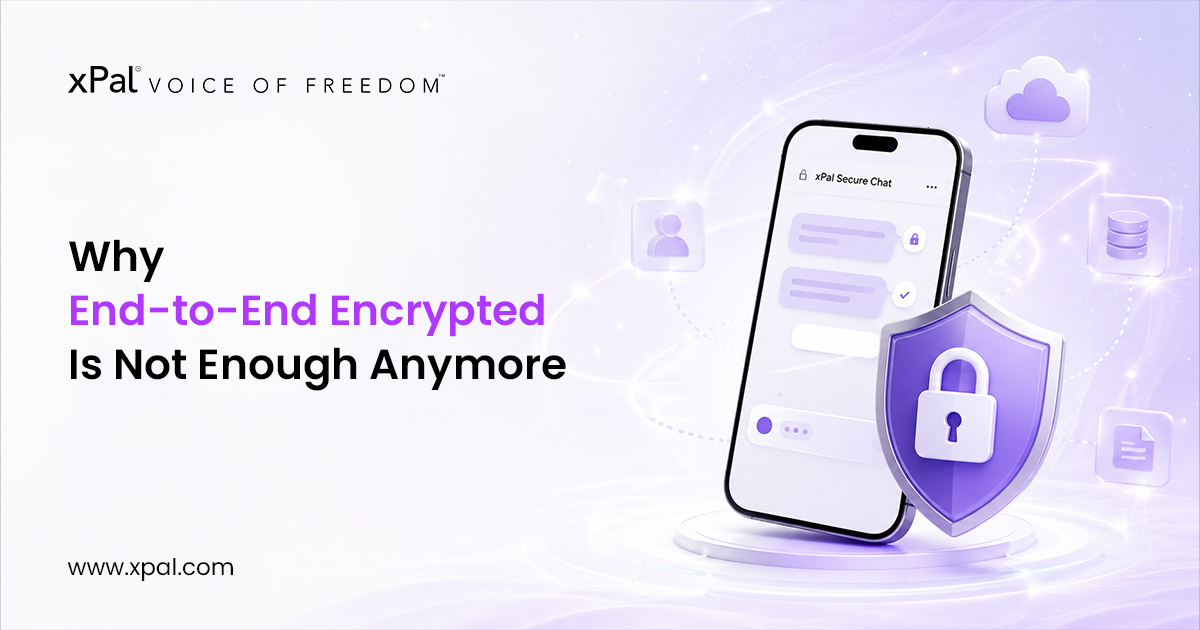
Why “End-to-End Encrypted” Is Not Enough Anymore
For years, "end-to-end encrypted" was the phrase people searched for when picking a messaging app. It made sense.
If a service used end-to-end encryption, your messages were kept safe from outsiders while they traveled between devices. That’s still important. But encryption is just one part of keeping your communication private.
Now, almost every big messaging platform uses the phrase "end-to-end encryption" in some way. Because of that, the term alone isn’t as useful as it once was. It tells you something about the message content, but it doesn’t necessarily tell you who can find out who you are, what data is being collected, if your calls are secure, or if your contacts are visible.
The real question isn’t just, "Is this app encrypted?" The better question is:
What information does the app share even when the message itself is encrypted?
That is where modern privacy protection becomes more complicated. A truly private messaging app must protect more than the words inside a chat. It should also reduce identity exposure, limit metadata, secure calls, protect group conversations, and give users control over stored information.
Encryption protects content, not everything
End-to-end encryption is made to keep the content of a message safe from people who aren't supposed to see it. In a regular encrypted chat, the message stays locked on the sender's device and only opens when it reaches the recipient's device.
This security is important, but it doesn't always hide all the other information about the conversation. Depending on the platform, some details, called metadata, might still be visible.
These can include:
- Who made an account.
- Which phone number or email is linked to the account.
- Who is talking to whom.
- When messages are sent.
- How often people chat.
- The size and timing of files that are shared.
- Which devices or services are being used.
- Group memberships and how accounts are connected.
Even if no one can read the message itself, all that extra information can still show a clear picture of someone's habits and the people they talk to.
That's why the word "encrypted" shouldn't be seen as a full guarantee of privacy.
A good secure messaging and calling app should keep the message content safe while also minimizing the collection of extra information.
Identity exposure is the overlooked risk
Most popular messaging apps tie your account to a phone number. This helps you find friends more easily, but it also connects your personal identity to your phone communications.
A phone number can usually be linked to:
- Your name.
- Your social media profiles.
- Your job.
- Your location history.
- Your family members.
- Your online accounts.
- Your public records.
If someone uses your number to sign up for a messaging app, it can become a way for others to find you, send you fake messages, or trick you into giving away personal information. This doesn’t mean that using a phone number to sign up automatically makes an app unsafe.
It just means users should be aware of the trade-off. Being convenient and staying private aren’t always the same thing.
An anonymous chat app works differently by letting people chat without using their real-world identity as the main way to connect with others.
According to xPal’s website, you don’t need a phone number, email, SIM card, contacts, or personal details to sign up. Instead, users get a unique nine-digit xID for messaging and calling.
This separation can make it harder for strangers to link your private chats with your real identity.
Metadata can reveal more than the message
Imagine your message content is fully protected. Yet, someone might still know you talk to a certain person every morning, share files with a particular group, and make calls at the same time each evening.
That information can be really useful.
Metadata can show who you're connected with, your daily habits, professional links, and any changes in your behavior.
In some cases, it might even show that you're in contact with a lawyer, journalist, doctor, employer, or private company. Photos and videos can also pose a metadata risk.
Depending on the file, shared media may include details about the device, time, location, or software used to create it.
xPal says its Photo & Video Sanitizer removes metadata from shared media before it's encrypted and sent. This is an example of privacy protection that goes further than just encrypting the message itself. Encryption keeps the communication safe, but metadata controls help limit what is revealed about the communication itself.
Calls need the same protection as messages
Many people pay a lot of attention to text encryption but often overlook voice and video calls. A private conversation can take place through messages, voice calls, video calls, or shared files. If only one of these formats is strongly protected, the whole communication system is still missing important security layers.
A secure messaging app should therefore offer protection for all these formats: text messages, voice calls, video calls, shared photos and videos, documents and other files, group chats, and communication history.
xPal claims that its audio and video calls are end-to-end encrypted and use peer-to-peer communication, meaning the calls aren’t stored on xPal servers.
However, users should still check the technical documentation and privacy policies before using any app for important conversations. Security is strongest when it’s backed by clear information, independent testing, and open development practices.
Group chats create a larger privacy surface
A one-on-one chat involves two people. A group chat can have ten, fifty, or even hundreds of members. Each new person joining adds another account, another device, another screenshot risk, and another access decision. This makes keeping group conversations private harder than keeping one-on-one messages private.
A good private group system should think about:
- Who can join the group.
- Who can invite new people.
- Whether new members can see old messages.
- What happens when someone leaves.
- How the group’s encryption keys are handled.
- If admins can remove someone’s access.
- How shared photos and files are kept safe.
A group can be encrypted but still not well managed.
If a former member still has access or if new members can instantly see private messages, then just having encryption isn’t enough.
xPal says its group messaging is end-to-end encrypted and designed to protect all members. The key idea is that private group chats need to focus on who can join and who can access the conversation, not just on encrypting the messages themselves.
Deletion is not always privacy
Many apps allow you to delete a message from your own device. However, this doesn't mean the message is gone everywhere else. A message can still be found in several places, such as on the recipient's device, in a cloud backup, in an app cache, in a notification preview, in a downloaded media folder, or on a server or synced device. Because of this, it's important for apps to clearly explain what their deletion options do. Users need to know if a message is only removed from their own device, deleted for everyone, taken out of backups, or just hidden.
xPal offers several tools to help users manage their communication history.
One feature, called Total Wipeout, deletes the message history from both the sender's and recipient's devices. Another feature, Terminate Mode, completely erases the entire chat history. Flicker Mode automatically deletes messages after a set time.
These features can be helpful, but it's important to remember that no app can stop a recipient from taking a screenshot or recording information outside of the app.
Certifications provide stronger evidence
Privacy marketing can be difficult to evaluate. Almost every service can describe itself as private, secure, or encrypted.
Independent assessment provides a more useful signal.
xPal states that it has cryptographic algorithms validated under the NIST Cryptographic Algorithm Validation Program. It also lists independent DEKRA cybersecurity audits, Google CASA/MASA certification through the App Defence Alliance, and secure development practices aligned with OWASP guidance.
These credentials should not be treated as a guarantee that every possible threat is eliminated. Rather, they provide evidence that specific technical, development, or security requirements have been assessed.
When evaluating a messaging service, look for:
- The name of the certification or audit.
- The organisation that issued it.
- The scope of the assessment.
- The date of the assessment.
- Whether the provider explains what was tested.
- Whether the claim links to supporting documentation.
This is more meaningful than relying on a general “military-grade encryption” statement.
What a complete privacy platform should offer
The modern threat model goes beyond just listening in on messages. Users need to think about more than just what they send — they should also consider things like who they are, information about their activity, access to their devices, calls, groups, files, backups, and even when things are deleted.
A communication platform that values privacy should ideally offer the following:
- Messages that are encrypted from end to end.
- Audio and video calls that are also encrypted from end to end.
- A way to sign up without needing too much personal information.
- A unique ID instead of using a phone number.
- No automatic access to your contacts.
- Protection of information about shared media.
- Strong control over who can join groups.
- Safe and secure storage for files.
- Options for messages that disappear after a set time.
- Easy-to-understand information about privacy.
- Independent checks on the app’s security.
- Good practices in how the app is built and developed.
xPal says it doesn’t look at your contacts or other data on your phone, and it doesn’t collect your name, phone number, email, or location.
Users should check the full privacy policy and app permissions for the latest version before deciding.
How to evaluate a messaging app
Before downloading any private messaging app, ask these questions:
Does it require a phone number?
If yes, decide whether convenience is worth connecting your identity to the account.
Is encryption enabled by default?
Some apps offer end-to-end encryption only in specific modes or conversations. Users should not have to guess whether a chat is protected.
Are calls encrypted?
Text encryption does not automatically guarantee secure voice or video calls.
What metadata is collected?
Read the privacy policy and look for information about contacts, usage patterns, device data, and account identifiers.
Are backups protected?
Encrypted chats may become less private if unencrypted backups are enabled.
What happens when someone leaves a group?
Ask whether former members lose access and whether new members can read old messages.
Are deletion features explained?
Find out whether deletion affects one device, both devices, servers, or backups.
Are security claims independently supported?
Look for audits, certifications, technical documentation, and clear dates.
Why xPal takes a broader approach
xPal's approach is built around the idea that encrypted content is just one part of keeping communications private. The platform brings together encrypted text, audio, and video messaging along with a nine-digit xID, metadata cleaning, private group chats, self-destructing messages, encrypted file storage, and tools for deleting communication history.
This makes xPal a good fit for people who worry about more than just someone listening in on their messages.
It could be useful for security experts, privacy-focused users, journalists, business professionals, and anyone looking for a clearer separation between their real identity and their digital interactions.
The key takeaway is straightforward: users shouldn't settle for just the word "encrypted." They should look into the full privacy setup to make sure their communications are truly secure.
Conclusion
End-to-end encryption is still important, but it's not the whole story.
It can protect the content of messages, but it doesn't hide who you are, the details about your communications, who you're talking to, the files you share, your group memberships, or your backup data.
In 2026, users should look at the whole communication system, not just rely on encryption as a complete solution.
A truly secure messaging app should protect both messages and calls, reduce the risk of exposing personal information, limit the data collected about your chats, allow safer group conversations, and clearly show that it's secure.
xPal handles these issues by using xID-based registration, encrypted messaging, removing metadata, offering private group chats, controlling chat history, and having independent security certifications.
Encryption is still necessary, but on its own, it's no longer enough.